Related Movies
Juna (2018)
A dream shows Juna that she has only one last day to live. Ignorantly she initiated the process itself. The attempt to avert her fate failed. A story about the problem of artificial life.

Can't Take My Eyes Off You (2025)
When her wife, Eurydice, is bitten by a snake and killed, Orpheus and her camera crew must journey down to the underworld to find the Offices of Hades. After overcoming obstacles and hardships, they reach their destination and plead with the King of the Dead to get Eurydice back.
Aap Ki Parchhaiyan (1964)
A family drama with a special focus on two generations of the Chopra family. Dinanath Chopra lives in a small tenement with his wife, and two sons Baldev, and Chandramohan. Dinanath re-finances his house in order to get Baldev to study further and be a doctor, and also gets him married with Rekha who comes from a very wealthy family. Chandramohan studies in college, and has a sweetheart in the form of the gorgeous Asha. Asha lives with her mom, and dad, a sort of quack. Differences in the Baldev emerge and multiply. Baldev and Rekha move to their palatial house. The birth of a baby boy to Rekha does lighten things up a bit, but not for long. Dinanath loses his eyesight in an accident and becomes blind.
Anjuman (1986)
A young woman leads impoverished chikan embroidery workers in Lucknow in a strike against the greedy wholesalers who exploit them.

Ayee Milan Ki Bela (1964)
Shyam works for Mr. Choudhry, and lives in a small village in India with his mother. Ranjeet, Shyam's childhood friend, returns from overseas, and all are overjoyed to see him back. Ranjeet and Shyam have a lot in common: Both are handsome, dedicated, pleasant and polite; Both share the same date of birth; and both also love the same woman, Barkha. It is the last similarity that causes friction between the two, so much so that Shyam is accused of impregnanting another woman, Roopa, and charged with stealing money.
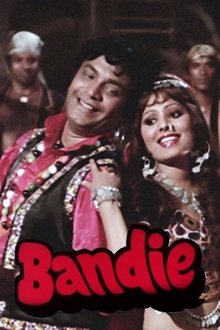
Bandie (1978)
Maharaj Brajbhan lives a wealthy lifestyle in Bharatpur, India along with his wife, Badi Rani, but have been unable to conceive for Bharatpur, and have no choice but to leave it's reigns with Brajban's widowed cousin, Vikram, and his son, Kanchan. When Vikram finds out that Badi Rani is pregnant, he plots to first sully her character by having her abducted, then shunned by the Maharaj, and then decides to have her killed. But her killer has a change of heart and lets her live. She gives birth to a son, names him Bhola, and starts living a simple lifestyle in a Mandir with the help of it's Poojary. Years later Vikram finds out she is alive and kills her, as well the Poojary and the Poojary's son. Bhola witnesses this, manages to escape, starts to live with a poor widow, grows up uneducated, and makes a living through crime.

Dil Diya Dard Liya (1966)
A kind-hearted, widowed landlord, Thakur, lives a wealthy lifestyle with his son, Ramesh; daughter, Roopa; and an adopted child, Shankar. Ramesh hates Shankar and often abuses him. Years pass by, Thakur has passed away, and all three children have grown up. While Ramesh visits a stunningly attractive Courtesan, Tara, drinks alcohol, and continues to abuse and mercilessly beat Shankar, who bears this in silence as he and Roopa are in love with each other. When Ramesh finds out that Roopa wants to wed Shankar, he has him severely beaten and thrown off a cliff. He then arranges Roopa's marriage with another wealthy man, Satish, while he continues to romance Tara and even signs over his entire estate and home to her name.
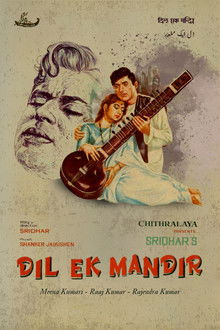
Dil Ek Mandir (1963)
Dr. Dharmesh (Rajendra Kumar) and Sita (Meena Kumari) are in love, and hope to marry on Dharmesh's return from abroad. When Dharmesh returns, he is devastated to find that Sita has married someone else. He then decides to devote the rest of his life at a cancer clinic. One of his patients is Ram (Raaj Kumar), who is critically ill, and has to be operated upon. Things progress well, until Dharmesh meets Ram's wife - none other than Sita. Dharmesh now has to battle with his conscience, and his medical ethics to save Ram or to let him pass away, so that he can marry Sita.
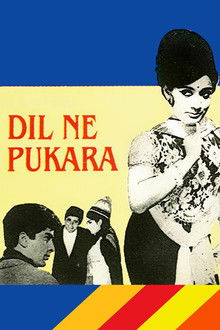
Dil Ne Pukara (1967)
Asha lives a wealthy lifestyle in Bombay with her widowed dad, who would like her to get married to Dr. Prakash. While vacationing in Kashmir, she meets with a young man, Rajan, and both fall in love with each other. When she returns home and attends Dr. Prakash's birthday party, she gets a pleasant surprise when she finds out that Rajan is Prakash's friend. Rajan introduces Asha to his mom, while Asha introduces Rajan to her dad, and both parents approve of their match. Before they can get engaged, Rajan had promised his late father that he would obtain a degree from Oxford University, and be back after one year. He decides to travel by boat, which meets with an accident and there are no survivors. A shocked and devastated Asha finds out that Rajan's death has killed her dad, and she throws herself in her work as a doctor, working side by side with Prakash.
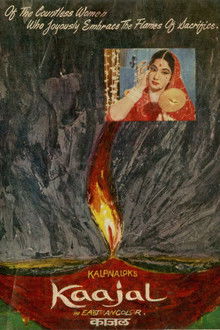
Kaajal (1965)
Raised by a kind matriarch, Madhavi (Meena Kumari) shares a close bond with her foster brother Rajesh (Dharmendra). When Rajesh marries the insecure Bhanu (Padmini), Madhavi faces false accusations and attempts suicide. Rescued by Moti (Raaj Kumar), she marries him, only to discover his manipulative and exploitative true nature, leaving her trapped in a life of further sorrow.
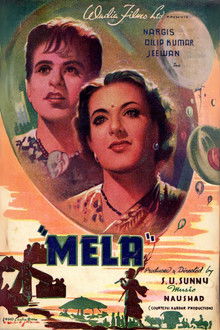
Mela (1948)
A convicted murderer is released from prison. His only possession is a broken figurine - the last token of his love. The tragic story of how he came to be incarcerated and the significance of the figurine is the subject of this tale of star-crossed lovers whose destiny is moulded by society's rigid rules and the villainy of a scoundrel.
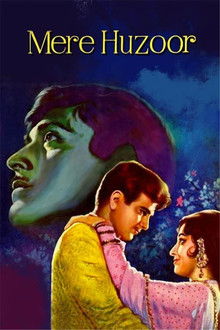
Mere Huzoor (1968)
Akhtar Hussain saves the life of Nawab Salim, and earns his gratitude. Salim invites Akhtar to come to his palatial home, and Akhtar does so. On the way, he meets beautiful Saltanat, and falls in love with her. On arrival at Salim's house, Akhtar is treated with utmost respect, provided employment, and a place to live. Akhtar meets with Saltanat and both plan to get married. Unknown to them, Salim also loves Saltanat, but Saltanat rejects his advances, and proposal, leaving his heartbroken. Soon Saltanat and Akhtar get married and settle down. Saltanat soon gives birth to a son. Salim is very affectionate with this child, and the child too grows to like Salim. Akhtar, meanwhile, has fallen in bad company, drinks alcohol, and romances a courtesan.
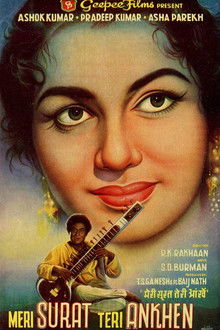
Meri Surat Teri Ankhen (1963)
Raj Kumar is a wealthy businessman and dislikes everything ugly. When his wife, Kamla, becomes pregnant and gives birth to an ugly son, he asks the attending Dr. Mathur to inform his wife that their child was still-born. Dr. Mathur places the child in the hands of Rahmat and his wife, Naseeban, who welcome him with open arms. But misfortune follows them, as the child, who is named Pyare, accidentally burns their dwelling down, killing Naseeban. Rahmat then re-locates to his village when he teaches Pyare the skills required to play musical instruments and sing. Years later, Rahmat passes away, and informs Pyare that he is really a Hindu. Dr. Mathur fills the rest of the blanks for Pyare, and arranges a song and dance play and hopes that Raj will overcome his dislike for his now-grown son.
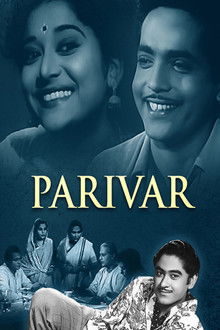
Parivar (1956)
A joint family consisting of four brothers, their wives, and their respective children, living under one roof. Some of the brothers are professionls, one a lawyer, a doctor, and others businessmen. They are a happy family, living and sharing each other's joys and sorrows. Then one day, an arguement breaks out over a glass of milk, and the entire family is thrown into chaos, and the only resolution seems to be nothing but dividing the entire property amongst the brothers and their respective families.
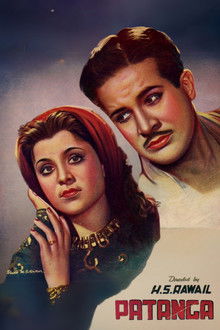

Floating Weeds (1959)
When a theater troupe's master visits his old flame, he unintentionally sets off a chain of unexpected events with devastating consequences.
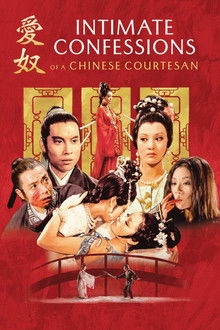
Intimate Confessions of a Chinese Courtesan (1972)
18-year-old Ainu is kidnapped and sold to a brothel. Her good looks and wild personality make her very popular with the lustful clients, but also draw the lesbian attentions of brothel madam Chun Yi. Chun Yi teaches Ainu the ways of lust and the ways of kung fu, and Ainu becomes more and more similar to her captor. But rage at her treatment is still burning inside her.

Mary, Queen of Scots (1971)
Mary Stuart, who was named Queen of Scotland when she was only six days old, is the last Roman Catholic ruler of Scotland. She is imprisoned at the age of 23 by her cousin Elizabeth Tudor, the English Queen and her arch adversary. Nineteen years later the life of Mary is to be ended on the scaffold and with her execution the last threat to Elizabeth's throne has been removed. The two Queens with their contrasting personalities make a dramatic counterpoint to history.
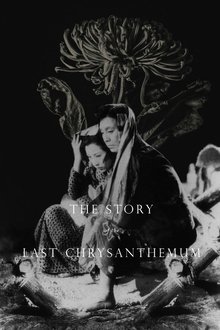
The Story of the Last Chrysanthemum (1939)
In late 19th century Tokyo, Kikunosuke Onoue, the adopted son of a legendary actor, himself an actor specializing in female roles, discovers that he is only praised for his acting due to his status as his father's heir. Devastated by this, he turns to Otoku, a servant of his family, for comfort, and they fall in love. Kikunosuke becomes determined to leave home and develop as an actor on his own merits, and Otoku faithfully follows him.