In her public persona, Eleanor “Tussy” Marx was a translator, actress, a children’s rights activist and a persuasive labour organizer, a tireless powerhouse determined to carry on her father’s work. She held her own with twentieth century gods, including both her father and his colleague Engels. In her privately life, however, she was vulnerable and her attraction to the self-indulgent and self-important Edward Aveling led her into misery and ultimately proved fatal.
Related Movies

Together (2000)
Elisabeth leaves her abusive and drunken husband Rolf, and goes to live with her brother, Göran. The year is 1975 and Göran lives in a commune called Together. Living in this leftist commune Elisabeth learns that the world can be viewed from different perspectives.

The Last Emperor (1987)
A dramatic history of Pu Yi, the last of the Emperors of China, from his lofty birth and brief reign in the Forbidden City, the object of worship by half a billion people; through his abdication, his decline and dissolute lifestyle; his exploitation by the invading Japanese, and finally to his obscure existence as just another peasant worker in the People's Republic.


100 Years (2021)
As the Communist Party of China celebrates its 100th anniversary, this documentary looks back at the party’s history, from the 1920’s, to the Civil War, the Great Leap Forward, the Great Famine, the Cultural Revolution and the reforms by Mao Zedong and Deng Xiaoping. Did the Great Famine cost more than 15 million lives? How does the Cultural Revolution continue to shape Chinese politics today? What was capitalism like after Mao’s death? Through rare and never-before-seen historical footage, expert interviews and eyewitness accounts of the Great Famine, Tiananmen incident, and the Cultural Revolution, get to know how one party has so profoundly shaped China.

The Unbearable Lightness of Being (1988)
Successful surgeon Tomas leaves Prague for an operation, meets a young photographer named Tereza, and brings her back with him. Tereza is surprised to learn that Tomas is already having an affair with the bohemian Sabina, but when the Soviet invasion occurs, all three flee to Switzerland. Sabina begins an affair, Tom continues womanizing, and Tereza, disgusted, returns to Czechoslovakia. Realizing his mistake, Tomas decides to chase after her.

30 Years of Democracy (2019)
Two journalists born in the mid '80s decide to take a look back at how their country changed in the last 30 years since the fall of communism. The end product is a documentary containing footage of political events and historical milestones significant to Romania accompanied by a narrator's voice walking the viewer through the events, and also interviews with Romanian politicians and other influential public figures sharing their thoughts and their different views on those events.

ABC Book (1976)
A staged cinematic parable, it presents in symbolic images a painful diagnosis of Poles' sense of identity in the 1970s.

The Barbarian Invasions (2003)
In this belated sequel to 'The Decline of the American Empire', middle-aged Montreal college professor, Remy, learns that he is dying of liver cancer. His ex-wife, Louise, asks their estranged son, Sebastian, a successful businessman living in London, to come home. Sebastian makes the impossible happen, using his contacts and disrupting the Canadian healthcare system in every way possible to help his father fight his terminal illness to the bitter end, while reuniting some of Remy's old friends, including Pierre, Alain, Dominique, Diane, and Claude, who return to see their friend before he passes on.

As Long as There’s Life in Me (1965)
This is part one of a two-part biopic about Karl Liebknecht. In 1914, Germany is arming itself for war. Karl Liebknecht, left-wing revolutionary Social Democrat, workers’ leader and a virulent antimilitarist, is one among 110 SPD members of Parliament who vote against approving war loans. From then on, he is considered un-German and a traitor to the fatherland, and his own party’s leadership turns against him. Despite threats, Liebknecht speaks up against the war and writes the manifesto “The Main Enemy Is at Home.” Even when he is arrested and charged with treason, he does not surrender.

Ted K (2021)
An exploration of Ted Kaczynski's life in Lincoln, Montana in the years leading up to his arrest as The Unabomber.

Carmen and the Reds (1939)
Javier Navarro, a Falangist, is ordered to infiltrate Republican Madrid to deliver a message to a member of the Fifth Column.

Citizen X (1995)
Based on the true story of a Russian serial killer who, over many years, claimed victim to over 50 people. His victims were mostly under the age of 17. In what was then a communists state, the police investigations were hampered by bureaucracy, incompetence and those in power. The story is told from the viewpoint of the detective in charge of the case.

Strawberry and Chocolate (1993)
In 1979 Cuba, flamboyant gay artist Diego attempts to seduce straitlaced David, an idealistic young communist, and fails dismally. But David conspires to be "friends" with Diego so he can monitor the artist's subversive life for the state. As Diego and David discuss politics, individuality and personal expression in Castro's Cuba, a genuine friendship develops between the two.

The Sailor's Song (1958)
A film about the historical uprising of the seamen in Kiel: During the Russian October Revolution of 1917, German and Russian soldiers start to solidarize with each other. By disarming the officers, machinist Henne Lonke and stoker Jens Kasten prevent the attack on a Russian freighter. When German admiralty gives out orders for operation "Nibelungen", which would lead the German fleet into a suicidal attack against England and quell the revolutionary spirit, seamen and soldiers from different political backgrounds unite in protest.

Miracle (2018)
Close to bankruptcy, Irena, the owner of a struggling pig farm in a tiny post-Communist town, finds a surprising benefactor in a handsome American man who appears to be the answer to all her prayers.

...And She Chose Hell (1957)
In Western Germany, two brothers and their organization help people escape to non-communist Germany. A policeman chasing them falls in love with the sister and feels divided between love and duty.

Kolya (1996)
After a fictitious marriage with a Russian emigrant, Cellisten Louka, a Czech man, must suddenly take responsibility for her son. However, it’s not long before the communication barrier is broken between the two new family members.
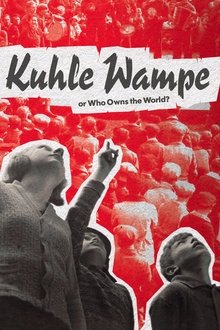
Kuhle Wampe or Who Owns the World? (1932)
Kuhle Wampe takes place in early-1930s Berlin. The film begins with a montage of newspaper headlines describing steadily-rising unemployment figures. This is followed by scenes of a young man looking for work in the city and the family discussing the unpaid back rent. The young man, brother of the protagonist Anni, removes his wristwatch and throws himself from a window out of despair. Shortly thereafter his family is evicted from their apartment. Now homeless, the family moves into a garden colony of sorts with the name “Kuhle Wampe.”