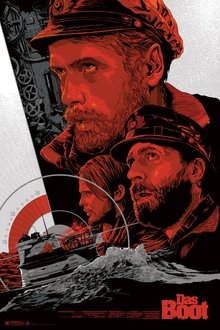
The untold story of a Royal "propagandist in pearls" whose wartime friendship with President Roosevelt became a vital catalyst to win back freedom for her tiny occupied country.
Related Movies

Flags of Our Fathers (2006)
There were five Marines and one Navy Corpsman photographed raising the U.S. flag on Mt. Suribachi by Joe Rosenthal on February 23, 1945. This is the story of three of the six surviving servicemen - John 'Doc' Bradley, Pvt. Rene Gagnon and Pvt. Ira Hayes - who fought in the battle to take Iwo Jima from the Japanese.
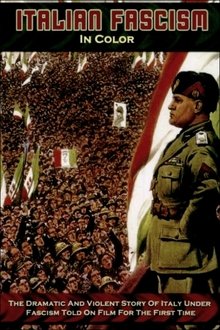
Fascism in Colour (2006)
After the World War I, Mussolini's perspective on life is severely altered; once a willful socialist reformer, now obsessed with the idea of power, he founds the National Fascist Party in 1921 and assumes political power in 1922, becoming the Duce, dictator of Italy. His success encourages Hitler to take power in Germany in 1933, opening the dark road to World War II. (Originally released as a two-part miniseries. Includes colorized archival footage.)

Vom Nazi zum englischen Fußballidol - Torwartlegende Bert Trautmann (2021)
How could a German Wehrmacht soldier become a celebrated soccer idol of the Britons in the post-war period? The documentary by Radio Bremen shows the moving life story of the soccer star of the 1950s in a torn Europe and how an enemy became a friend. With his legendary appearance in the English Cup Final 1956, in which he played until the end despite a broken neck, Bert Trautmann set up a memorial for himself in the history of sport. Already in the same year, he is chosen as England’s footballer of the year, and by his club Manchester City even as best player of all times. Bernhard “Bert” Trautmann is one of the most popular and best-known soccer players in England.

The Bride and the Curfew (1978)
Shpresa goes to the house of fascist collaborators to commit an assassination. After that, dressed as a bride, she becomes an illegal.

The Reckoning: Remembering the Dutch Resistance (2007)
The documentary that captures the compelling story and eyewitness account of six survivors in war-torn Netherlands during World War II.

The Girls with the Red Ribbons (1978)
Jeta is a student who is a member of the illegals and tries to create a group of antifascist girls in her school.

Olympia 1936. Der verratene Traum (2016)
The film chronicles the story of how the Nazis and the IOC turned, to their mutual benefit, a small sports event into the modern Olympics. The grand themes and controversial issues from the 1936 Games have continued to this day: Monumentality, budget overruns, collusion with authoritarian regimes, corruption and sometimes even bribery.

The Peaks of Zelengore (1976)
During the Battle of Sutjeska, partisan troops must endure 24 hours of big and heavy attacks on German units Ljubino grave, to the main Partisan units, with the wounded and the Supreme Headquarters, pulled out the ring that is tightened around them.
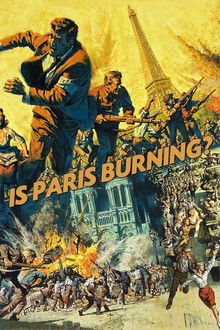
Is Paris Burning? (1966)
Near the end of World War II, Gen. Dietrich von Choltitz receives orders to burn down Paris if it becomes clear the Allies are going to invade, or if he cannot maintain control of the city. After much contemplation Choltitz decides to ignore his orders, enraging the Germans and giving hope to various resistance factions that the city will be liberated. Choltitz, along with Swedish diplomat Raoul Nordling, helps a resistance leader organize his forces.

Fort Saganne (1984)
In 1911, a willful and determined man from peasant stock named Charles Saganne enlists in the military and is assigned to the Sahara Desert under the aristocratic Colonel Dubreuilh.

Triple Cross (1966)
Safecracker Eddie Chapman is languishing in prison on the island of Jersey when the Nazis arrive. An adept manipulator of situations, Chapman convinces the Germans to use him to spy on the British. And when the would-be traitor arrives home, he convinces the English to use him as a double agent -- in exchange for a full pardon.
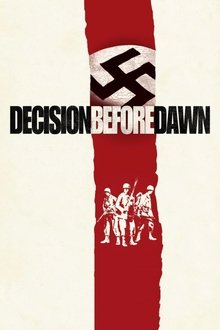
Decision Before Dawn (1951)
WWII is entering its last phase: Germany is in ruins, but does not yield. The US army lacks crucial knowledge about the German units operating on the opposite side of the Rhine, and decides to send two German prisoners to gather information. The scheme is risky: the Gestapo retains a terribly efficient network to identify and capture spies and deserters. Moreover, it is not clear that "Tiger", who does not mind any dirty work as long as the price is right, and war-weary "Happy", who might be easily betrayed by his feelings, are dependable agents. After Tiger and another American agent are successfully infiltrated, Happy is parachuted in Bavaria. His duty: find out the whereabouts of a powerful German armored unit moving towards the western front.

1900 (1976)
The epic tale of a class struggle in twentieth century Italy, as seen through the eyes of two childhood friends on opposing sides.
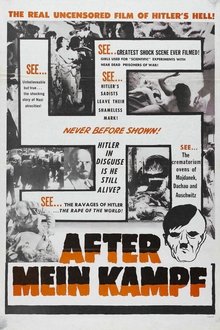
After Mein Kampf? (1961)
By combining actual footage with reenactments, this film offers both a documentary and fictional account of the life of Adolf Hitler, from his childhood in Vienna, through the rise of the Third Reich, to his final act of suicide in the waning days of WWII. The film also provides considerable, and often shocking, detail of the atrocities enacted by the Nazi regime under Hitler's command.

The English Patient (1996)
In the 1930s, Count Almásy is a Hungarian map maker employed by the Royal Geographical Society to chart the vast expanses of the Sahara Desert along with several other prominent explorers. As World War II unfolds, Almásy enters into a world of love, betrayal, and politics.

The Pianist (2002)
The true story of pianist Władysław Szpilman's experiences in Warsaw during the Nazi occupation. When the Jews of the city find themselves forced into a ghetto, Szpilman finds work playing in a café; and when his family is deported in 1942, he stays behind, works for a while as a laborer, and eventually goes into hiding in the ruins of the war-torn city.

Schindler's List (1993)
The true story of how businessman Oskar Schindler saved over a thousand Jewish lives from the Nazis while they worked as slaves in his factory during World War II.

To Be or Not to Be (1942)
During the Nazi occupation of Poland, an acting troupe becomes embroiled in a Polish soldier's efforts to track down a German spy.